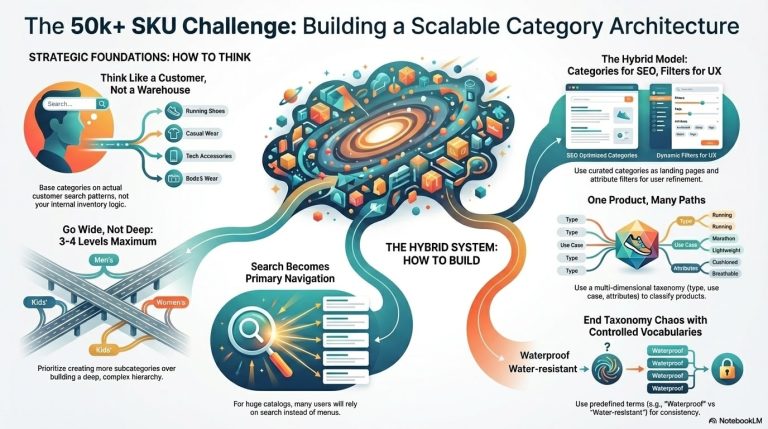
Scalable Category Architecture: Facets, Filters, Canonicals
Understanding Scalable Category Architecture
In today’s digital landscape, the organized presentation of content is crucial for user satisfaction and performance outcomes. Scalable category architecture serves as a structured framework that helps businesses categorize and present information efficiently, enhancing both user experience and search engine optimization (SEO). The main elements of scalable category architecture include facets, filters, and canonicals – each plays a vital role in ensuring that content organization remains intuitive and scalable over time.
Context
The need for scalable category architecture stems from the exponential growth of content across digital platforms. Businesses today face significant challenges when organizing vast arrays of products, articles, or multimedia content. As an example, an eCommerce site may host tens of thousands of products across various categories, subcategories, and attributes. In such scenarios, traditional methods of categorization quickly become inadequate.
Defining Key Concepts
Facets
Facets refer to the distinct categories or aspects that can be used to describe products or content. They allow users to filter and narrow down searches based on specific characteristics. For instance, a clothing store might use facets such as size, color, brand, and price range to help customers find their desired items seamlessly.
Filters
Filters are essentially the tools or options available to users for refining their searches based on the facets provided. In our clothing store example, after choosing the desired facets (e.g., color: blue; size: medium), users apply filters to adjust their searches and view only relevant results. Filters can be multi-select, allowing for a combination of criteria to be applied.
Canonicals
Canonical tags are critical for ensuring SEO effectiveness, especially in instances of duplicate content. When multiple URLs can lead to the same content (for example, different filters applied to the same category), canonical tags help define the primary version of that content. Without proper use of canonicals, search engines may struggle to determine which version should rank, leading to diluted SEO benefits.
Practical Examples
To illustrate these concepts effectively, let’s explore their application across various industries:
eCommerce
In an online marketplace, a user searching for “running shoes” may encounter multiple facets to narrow down their choices:
- Brand: Nike, Adidas, Puma
- Type: Trail, Road, Cross-trainers
- Size: 6, 7, 8, 9
- Color: Red, Blue, Green
By applying these filters simultaneously, users can find precisely what they want without sifting through irrelevant results. Additionally, a canonical tag ensures that all search variations lead back to a single version of the product page, thereby boosting its SEO ranking.
Content Management Systems (CMS)
A news website might categorize articles by various facets like:
- Category: Politics, Sports, Technology
- Date Published: Today, This Week, This Month
- Author: John Doe, Jane Smith
Readers can filter for articles published by specific authors within particular categories. Again, canonical tags will help maintain SEO integrity, directing all article links back to a central version.
Steps to Implementation
1. Identify the Content
Begin by assessing the type and breadth of content your platform hosts. Understanding the depth and variety will guide your choice of facets and filters.
2. Define Facets and Filters
Solidify the key characteristics that your users will need. Consider user behavior and how they typically seek out information or products. Collaborate with stakeholders to ensure the facets are comprehensive yet concise.
3. Develop a Flexible Structure
Your category structure must adapt as new content or products emerge. Use a hierarchical taxonomy that supports scalability, making it easy to add new facets or filters without disrupting the existing architecture.
4. Implement Canonical Tags
Ensure your development team understands how to apply canonical tags effectively. This includes training on identifying duplicate content scenarios and correctly tagging them to preserve SEO benefits.
5. Test and Iterate
Once implemented, conduct usability tests with real users to gather feedback. Observe how easily they navigate the site and refine facets and filters as necessary. Continuous improvement should be a key principle.
Benefits and Drawbacks
Benefits
- Enhanced User Experience: Users can find what they’re looking for quickly, leading to increased satisfaction and engagement.
- Improved SEO: Proper use of canonical tags ensures that your website maintains solid SEO standing, preventing content dilution.
- Scalability: The structure easily accommodates new products or content, making it future-proof against growth.
- Data-Driven Insights: Analyzing interactions with facets and filters can provide valuable customer insights, informing future strategies.
Drawbacks
- Complexity: Setting up and maintaining a scalable category architecture can be a complex process, requiring careful planning and development.
- Over-Categorization: Too many facets and filters can overwhelm users, leading to decision fatigue.
- Resource Intensive: It may demand more resources, both in terms of technology and personnel, especially during the setup phase.
- Potential for Inaccuracies: If not maintained correctly, there might be inconsistencies in categorization that confuse users.
Common Mistakes
1. Overcomplicating the Structure
Creating an overly complex network of categories can lead to user frustration. Aim for simplicity, allowing users to navigate easily without feeling overwhelmed.
2. Ignoring User Behavior
Failing to analyze how users interact with your site can lead to misplaced facets and filters. It’s vital to study user patterns and preferences to tailor the experience effectively.
3. Neglecting the Canonicals
Omitting canonical tags in scenarios of duplicate content can severely impair your SEO. Make canonicalization a priority from the outset.
4. Lack of Continuous Improvement
Assuming that the architecture is perfect post-launch can hinder long-term performance. Regularly solicit feedback and stay updated about industry trends.
Checklist for Successful Implementation
- Identify and categorize your content accurately.
- Define clear, user-friendly facets and filters.
- Ensure a flexible structure for scalability.
- Apply canonical tags where necessary.
- Conduct user testing for feedback.
- Continuously analyze and iterate on the architecture.
Conclusion
Scalable category architecture, defined through facets, filters, and canonicals, is essential in the modern digital realm. It not only enhances user experience but also bolsters SEO efforts, making it a critical component for content-rich platforms. By understanding its elements, implementing thoughtfully, and avoiding common pitfalls, organizations can create an efficient and effective content discovery system that meets the needs of both users and search engines alike.